PNGUoT Secures Grant for Research into Biofuel Production from Organic Waste
The Papua New Guinea University of Technology (PNGUoT) has secured AUD 36,000 in international research funding to investigate the conversion of organic waste into advanced biofuels, with potential applications for rural and island communities across the Pacific.
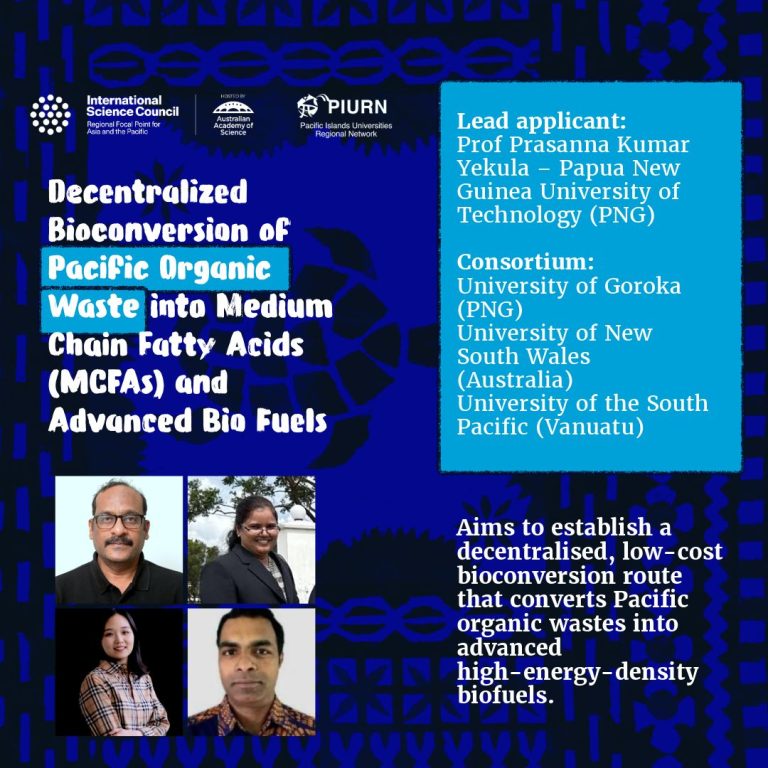
The funding, awarded through the TUPU Pacific Research Grants programme of the International Science Council Regional Focal Point for Asia and the Pacific (ISC RFP-AP), will support a collaborative research project led by Professor Prasanna Kumar Yekula of PNGUoT’s School of Mining Engineering, Faculty of Engineering.
The grant is administered by the Australian Academy of Science, with the research scheduled to run from February 2026 to March 2027.
Professor Yekula said the project presents an opportunity to address waste management and energy challenges through scientific research.
“This work is significant because it transforms a locally available waste problem into an opportunity for clean energy and research innovation. By converting Pacific organic waste into advanced biofuels, the project brings together waste management, renewable energy, scientific capacity building and circular-economy principles, while developing knowledge and technologies that can be adapted to the needs of Pacific communities.”
The research will investigate how organic waste from agricultural activities, food processing, markets and households can be converted into medium-chain fatty acids (MCFAs) through anaerobic fermentation, a biological process that takes place without oxygen.
These fatty acids will subsequently undergo chemical conversion into compounds known as MCFA methyl esters, which will be assessed for their potential use as renewable fuels.
The project responds to challenges facing Papua New Guinea and other Pacific Island countries, including dependence on imported fossil fuels, rising fuel costs and limited waste management infrastructure. For rural and remote communities that rely heavily on imported diesel for electricity generation and transportation, locally produced alternative fuels could offer opportunities to improve energy resilience.
The research will therefore examine the technical, economic and environmental feasibility of developing small-scale, decentralized biofuel production systems suited to Pacific conditions.
Professor Yekula further highlighted the project’s significance in strengthening regional research capacity and collaboration.
The project brings together PNGUoT as the lead institution, the University of Goroka, the University of the South Pacific’s Emalus Campus in Vanuatu, and the University of New South Wales in Australia.
Through this partnership, postgraduate students and early-career researchers will gain training in fermentation processes, analytical chemistry, biofuel development and sustainability assessment.
The research will also generate scientific data, analytical procedures and technical knowledge that can support future investigations and potential applications by communities, industries and policymakers.
Planned outputs include an open-access journal article, research datasets, standard operating procedures, a policy brief and knowledge-sharing activities. The project is expected to provide a foundation for further research funding and future community-scale demonstrations of waste-to-energy technology.
It also contributes to PNGUoT’s research capacity in renewable energy while supporting broader efforts to develop sustainable waste management and alternative energy solutions for Papua New Guinea and the Pacific.