
PNGUoT School of Business Showcases Research Excellence at 2026 PNG IPA Business Regulators Summit
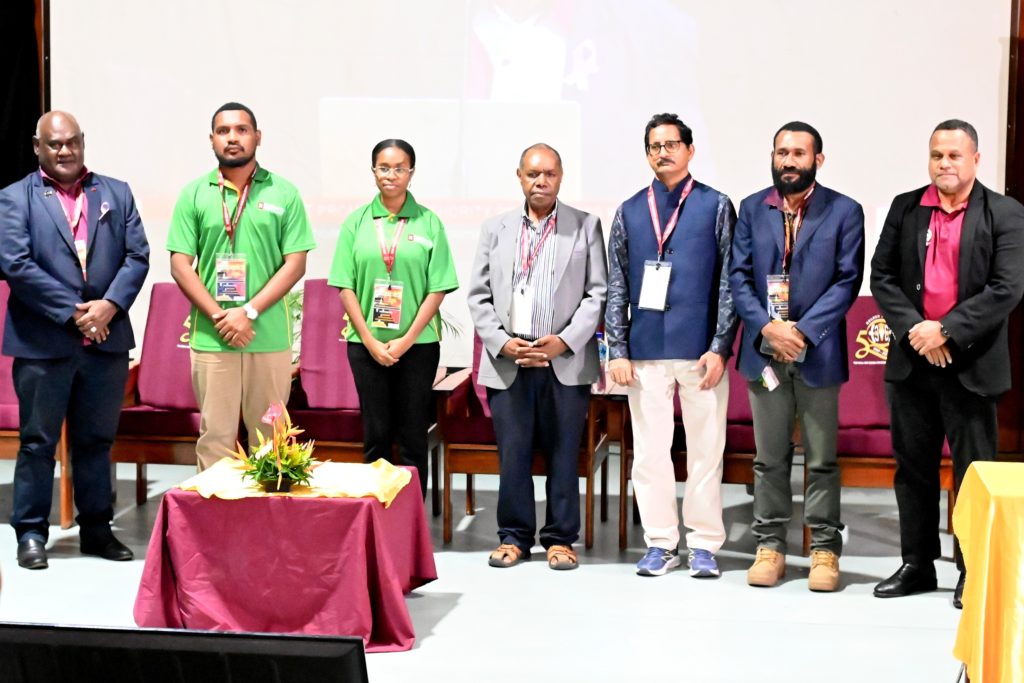
The Papua New Guinea University of Technology's (PNGUoT) School of Business has strengthened its engagement with the government by showcasing its research capabilities at the recent 2026 PNG Business Regulators Summit, paving the way for future collaboration in evidence-based policy development.
The School of Business was invited by the Investment Promotion Authority (IPA) to participate in the 2026 PNG Business Regulators Summit which was hosted at PNGUoT’s Duncanson Hall on the 8th and 9th of July. The Business Regulators Summit brought together Government Departments and key Regulatory agencies to discuss and review Reserved Activities List (RAL) policy reform and the role of research in shaping national decision-making on registration and administration of Reserved Activities List.
Representing PNGUoT were the Section Head of Applied Economics, Mr. Theo Michael, and School of Business, Postgraduate Coordinator and Senior Lecturer, Dr Vishwa Nadiminti, who presented proposition on data-driven research to assist IPA as a key Regulatory Agency in reviewing existing policies and identifying areas requiring improvement.
Mr. Bomoteng explained that regulatory government agencies specifically requested evidence-based presentations to support policy reviews on the Reserved Activities List to help determine where programmes and activities could be strengthened through collaborated effort.
Mr. Bomoteng said the School of Business presentation and debate by students led by William Raka, Hanako Nambari as debaters, Mel Labeli and Reeves Tewi support research team became the culminating presentation, highlighting the summit closure after a two days high profile summit sponsored by IPA Board Chairman Leon Buskins, the IPA Board and the IPA Management team.''
“The students were well prepared for the debate despite the short notice, on Student Debate & Research Pitch speaking for For and Against RAL topic: Should Government give more protection to local businesses or open up more sectors for international participation?” With the debate positions on affirmative side speaking on emphasizing • “RAL is essential for national capacity building”, and the negative on • “RAL distorts markets and discourages innovation”.
The summit also created new opportunities for collaboration between PNGUoT and the Investment Promotion Authority (IPA). Mr. Bomoteng said discussions are underway to establish a formal partnership focused on collaborative research and practical solutions for government agencies.
He noted that there is an opportunity for the School of Business’s Business IT Section staff and students also to engage in addressing operational challenges faced by government institutions by developing digital solutions, improving systems and applying emerging technologies as part of their participation in real time, real problem solving activities.
"Students can identify the gaps and create some apps or programs. They can even use AI, as long as we find solutions to the common problems affecting IPA and other regulatory agencies," he said.
Among the issues discussed were duplication in licensing processes, inefficient record-keeping systems and limited coordination between regulatory bodies. Mr. Bomoteng said these challenges provide valuable opportunities for student-led innovation and applied research.
He added that both organizations are now working towards signing a Memorandum of Understanding (MoU), which will strengthen research collaboration, create practical learning opportunities for students and enable the University to contribute directly to solving national development challenges.
The summit which was hosted by the IPA at PNGUoT marked an important milestone for the School of Business, demonstrating the University's growing reputation as a trusted partner in providing research expertise and innovative solutions to support evidence-based policymaking in Papua New Guinea for the Public Sector as well.
The School of Business appreciates the great opportunity to showcase the Students and Staff efforts in participation with one key Regulatory Agency in shaping the regulatory framework in enabling and empowering them to effectively administer the mandated function of government.