PNGUoT and K92 Mining Partner to Advance Agriculture and Rural Livelihoods
The Papua New Guinea University of Technology (PNGUoT) has entered into a three-year partnership with K92 Mining Ltd to apply the University’s agricultural research and technical expertise to sustainable agriculture and livelihood development in communities within the K92 Mine project area.
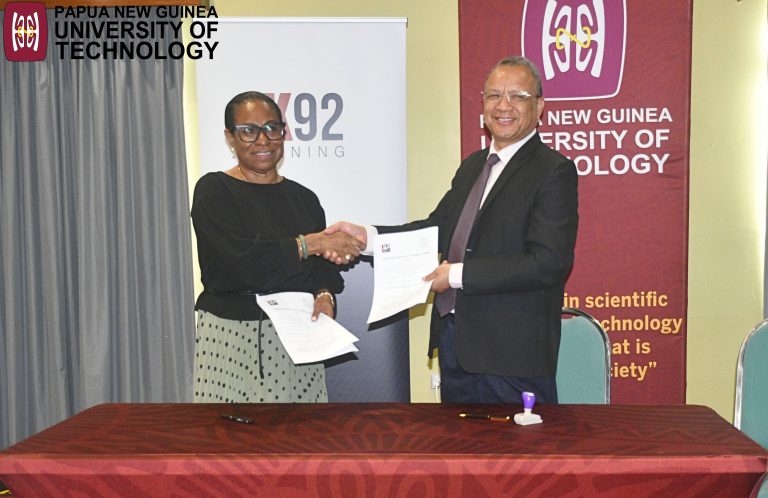
The Memorandum of Understanding (MoU), signed on 27 July 2026, establishes a formal framework for cooperation between K92 Mining and PNGUoT through the South Pacific Institute for Sustainable Agriculture and Rural Development (SPISARD), an outreach institute under the School of Agriculture.
The partnership will focus on sustainable agricultural systems, rural livelihoods, training and capacity building, value-chain development, market access, enterprise support and community planning.
It aims to strengthen food security, promote sustainable agricultural practices, improve resilience and adaptation to environmental and climate change, and contribute to the socio-economic development of communities.
Taking PNGUoT Research into Communities
PNGUoT Vice-Chancellor Professor Ora Renagi said the partnership reflects the University’s responsibility to ensure its scientific research and technological expertise produce tangible benefits for Papua New Guineans.
“The technology and science that we teach and generate through research must improve the lives of our people, from rural communities to citizens across the country.”
Professor Renagi said collaboration between universities and industry was important in transferring knowledge and technology into communities and creating economic opportunities for farmers.
“This is really how it should be: industry and universities working together to transfer technology, improve farmers’ productivity, find markets for their products and build supply systems.”
He said PNGUoT’s relationship with K92 Mining had previously included the recruitment of graduates in mining and engineering and was now being extended into agriculture and rural development.
“This partnership builds on our earlier collaboration with K92 in recruiting graduates from mining and engineering. Today, we extend that relationship into agriculture and rural development, ensuring that our research capability directly benefits farmers and communities.”
Professor Renagi also emphasised the importance of moving agriculture beyond subsistence production towards commercial farming that can generate sustainable household income.
“Only commercial farming will generate the income that helps people build better houses, pay school fees and improve their livelihoods.”
He said the partnership demonstrates how the University’s research and innovation can be translated into practical outcomes for society.
“This partnership promotes the profile of the university and demonstrates that the work we do can have a real impact on society.”
Strengthening Host Community Development
K92 Mining Principal for Strategic Community Investments and Social Development, Dulciana Somare-Brash, described the agreement as an important framework for combining PNGUoT’s scientific and technical expertise with K92 Mining’s community development initiatives.
She said agriculture remained an important sector for economic growth and sustaining rural communities, hence the partnership would enable K92 Mining to draw on the University’s expertise, research capabilities and technical resources to support agriculture and livelihood projects.
Somare-Brash also highlighted the importance of ensuring host communities are actively involved in initiatives undertaken through K92 Mining’s Sustainable Agriculture & Livelihood Plan (SALP).
“Our approach is to work hand-in-hand with communities and government partners so that agriculture and livelihood projects are not only impactful but also embedded within broader development frameworks.”
This approach is reflected in the MoU, which recognises the importance of transport and logistics, market access, renewable energy, digital connectivity and other supporting systems required to build resilient agricultural value chains. It also provides for coordination with District Development Authorities, Provincial Governments and development partners.
Building a Practical Industry-University Partnership
Under the MoU, SPISARD will provide technical expertise in agriculture, rural development and community mobilisation; undertake research, feasibility studies and baseline assessments; prepare project proposals and technical guidelines; and provide training, extension services and capacity-building programmes.
K92 Mining will provide financial and/or in-kind contributions as agreed for specific projects, facilitate access to communities within its operational or impacted areas, provide logistical support where required and integrate supported initiatives within its community affairs and corporate social responsibility framework.
Professor Peter Manus, Head of the School of Agriculture, also emphasised during the signing that agricultural research relevant to Papua New Guinea must be grounded in the realities of rural communities, with scientific findings translated into practical solutions that improve food security, livelihoods and resilience.
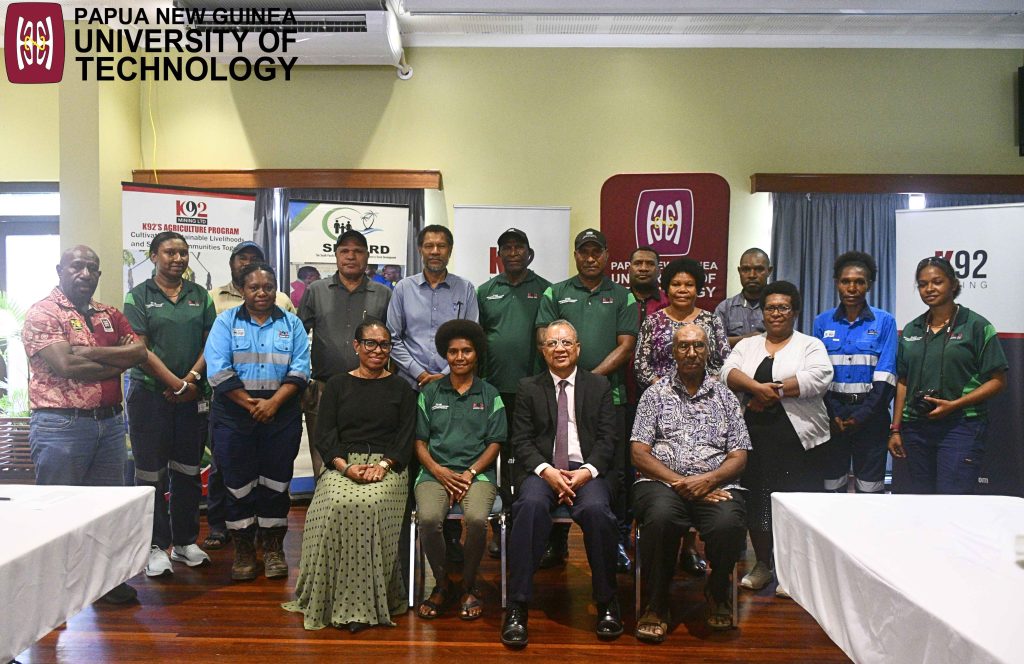
The signing was witnessed by representatives of landowner associations and Women in Mining, together with academic leaders and staff from PNGUoT’s Faculty of Natural Resources, School of Agriculture and SPISARD.
Professor Renagi said the University looked forward to a partnership that would produce tangible outcomes for communities.
“We look forward to a very strong working partnership with K92 Mining, and we want the results of this partnership to improve communities.”
The MoU will remain in effect for three years, with individual initiatives to be developed through specific project agreements or annexes under the broader cooperation framework.