FLOOD SUSCEPTIBILITY STUDIES VITAL FOR FLOOD RISK PLANNING IN PNG
Researchers at the Papua New Guinea University of Technology (PNGUoT) have conducted a series of inland flooding susceptibility studies that can aid in developing proper flood risk management systems in PNG.
Professor Sailesh Samanta at PNGUoT’s School of Surveying and Land Studies (SSLS) explained that Papua New Guinea’s geographical location makes it prone to natural disasters, and inland flooding in particular poses a critical threat to densely populated areas, critical economic centres, and publicly used services and facilities.
In addition to PNG’s vulnerability to natural disasters, the effects of climate change, through frequent and intense rainfall events, are also contributing to the threats of inland flooding.
“Regarding social, economic, and environmental perspectives, floods are one of the most devastating disasters in PNG. High-intensity downpours in a region often lead to flooding…floods are causing massive damage to natural and human resources…widespread flood analysis is very significant.”
The SSLS Geographical Information Systems (GIS) section conducted several studies using Remote sensing and GIS technology based on several methodologies, namely a multi-criteria decision support approach, an analytical hierarchy process, a frequency ratio model, a Ranking method, and a Boolean logic approach.
A series of six (6) studies were conducted from 2016 to 2024 with the collaboration of Bachelor students, Master’s students, and staff members. According to Professor Samanta, all these studies were focused on identifying areas prone to flooding, populations at risk, and infrastructure in vulnerable condition, enabling better land use planning, disaster risk reduction, and informed decision-making for flood management and mitigation strategies.
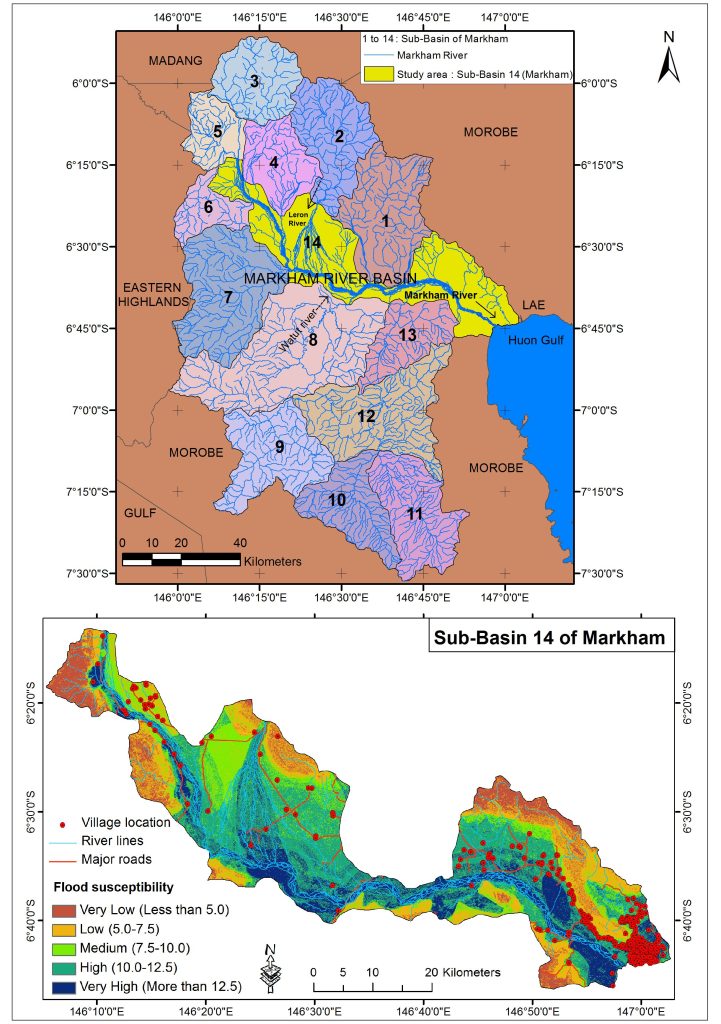
The research covered various regions, including the Markham and Busu Rivers, the Kemp-Welch Catchment in the Central Province, and the Sepik River basin. The studies produced accurate predictions about flood risks using tools like remote sensing and GIS. For example, one of the studies indicated a 97.7% accuracy rate, revealing that approximately 137,292 people live in flood-prone zones.
Professor Samanta said the findings from the studies observed how the different basin characteristics and other geographical factors can influence inland flooding within a basin.
“The approaches used in this research were based on logical conditions and reasoning. They can be considered in other river basins for identifying and mapping vulnerable areas for efficient planning and management.”
These studies have shown that flood susceptibility mapping is essential in developing warning systems, emergency services, and the prevention and mitigation of future flood management strategies.
Professor Samanta noted that this type of research is beneficial and efficient for local government administrators, researchers, and planners for developing flood mitigation plans. He added that the government authorities must now consider structural and non-structural flood mitigation measures to minimize the potential damage from floods, safeguarding resources and communities.
“Control of floods and prevention measures are necessary to reduce the potential damage to natural resources, agriculture, and infrastructure, among other areas, as well, ” Professor Samanta said.