
PNGUoT Launches School of Petroleum Engineering
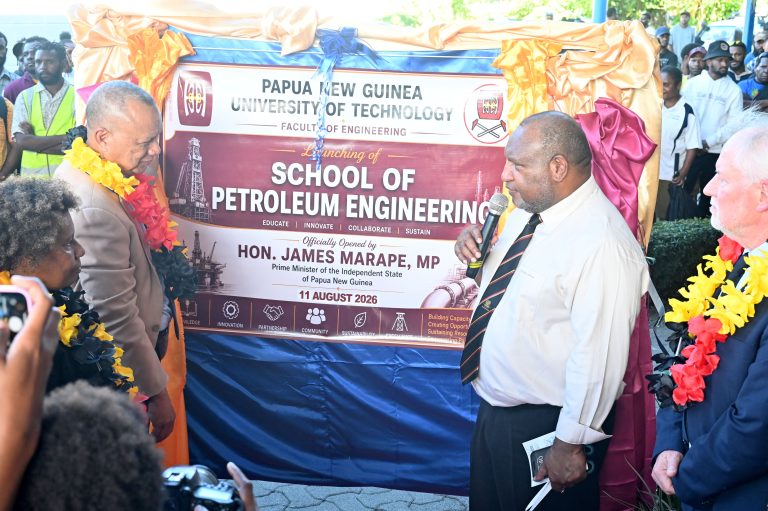
The Papua New Guinea University of Technology (PNGUoT) has officially launched its School of Petroleum Engineering, marking a significant step in developing the skilled national workforce needed to support Papua New Guinea’s petroleum and energy sector.
Prime Minister Hon. James Marape, MP, officially launched the School at PNGUoT’s Taraka Campus in Lae on Tuesday, 11 August 2026, with the first intake for the Bachelor of Petroleum Engineering (Honours) planned for Semester One, 2027.
Responding to PNG’s skills needs
Vice Chancellor Professor Ora Renagi OL OBE said the establishment of the School was a direct response to industry demand for more locally trained petroleum engineers.
“Our strong links with the mining and petroleum industries have brought us to this important day. The University has been working closely with the mining and petroleum industry and they have told us clearly that Papua New Guinea needs more highly trained engineers capable of supporting the petroleum sector. We have therefore responded,” Professor Renagi said.
“The launch of the Petroleum Engineering School today is not simply the introduction of another academic program. It is a direct response to the national skills requirement. It is also a demonstration of what can be achieved when universities, government and industry work together.”
Professor Renagi said the initiative was also part of PNGUoT’s broader strategy to diversify its academic programs and ensure the University remained responsive to Papua New Guinea’s changing development and workforce needs.
Prime Minister pledges Government support
Prime Minister Marape welcomed the establishment of the school, saying universities needed to continue adapting their programs to meet changing national and global workforce requirements.
He said Papua New Guinea had been an oil and gas producing nation for decades and the establishment of a dedicated petroleum engineering school was timely as the country seeks to develop more of its own professionals for the sector.
The Prime Minister also pointed to the international potential of Papua New Guinean engineers, recalling young PNG professionals he had met working at ExxonMobil’s headquarters in Houston, Texas.
“Papua New Guinea could be a niche supplier of high-quality engineers in special market need areas,” he said.
Prime Minister Marape pledged the Government’s support for the new School and PNGUoT’s continued development.
He said his government had provided K141 million to PNGUoT for infrastructure development over the past seven years and encouraged the University to develop a clear infrastructure plan as it expands its academic programs and student capacity.
He also encouraged PNGUoT to explore public-private partnerships and other government mechanisms to support infrastructure development, including partnerships with companies operating in Papua New Guinea’s resources sector.
“Let’s have a clear plan for this school. Let’s work to make it the best school in our part of the world,” Prime Minister Marape said.
Industry partnership key to developing workforce
Representing the resources and energy industry, PNG Chamber of Resources and Energy (PNG CORE) Vice President John Lewins said the launch was an important milestone in PNGUoT’s longstanding contribution to developing engineers and technical professionals.
“Today’s launch of the School of Petroleum Engineering is a milestone step in this journey,” Mr Lewins said.
He said Papua New Guinea’s resources sector needed engineers and technical professionals with strong academic foundations who could also adapt, think critically, solve complex problems, communicate effectively and understand the communities and environments in which resource projects operate.
These capabilities, he said, needed to be strengthened through meaningful exposure to real workplaces.
Mr Lewins said practical collaboration between universities and industry was therefore critical, with industry able to contribute through technical input, internships, professional work experience, mentoring, graduate development and exposure to current technologies and operating standards.
He said PNG CORE was keen to continue supporting PNGUoT by helping coordinate practical industry engagement and connecting the University with employers on future workforce needs.
“If our resources are to deliver enduring nation-building benefits, then we must build our people with the same seriousness and long-term commitment with which we build our projects,” Mr Lewins said.
About the program
The Bachelor of Petroleum Engineering (Honours) was developed by PNGUoT’s School of Mining Engineering under the leadership of the Faculty of Engineering Dean Dr Shoeb Syed, and Head of School Dr Wilson Kobal.
The program responds to a national skills gap in petroleum engineering. Despite Papua New Guinea’s significant petroleum and natural gas resources and major developments including PNG LNG, Papua LNG and the P’nyang Gas Development, the country’s locally trained petroleum engineering workforce remains limited.
The four-year degree will provide students with engineering foundations and specialised training in areas including petroleum geology and geophysics, drilling engineering, reservoir engineering, production engineering, natural gas engineering, offshore petroleum operations and reservoir simulation.
Practical industry exposure will form an important component of the program, with students required to complete at least 450 hours of approved professional work experience.
The program has been approved through PNGUoT’s internal academic processes and is currently being registered with the Department of Higher Education, Research, Science and Technology (DHERST), with the first intake planned for Semester One, 2027.
The establishment of the School of Petroleum Engineering strengthens PNGUoT’s role in preparing Papua New Guineans to participate professionally in the development of the country’s resources.
With the University responding to identified workforce needs, Government pledging its support and industry committing to continued collaboration, the new School will provide an important pathway for developing the specialised Papua New Guinean expertise required to support the country’s petroleum and energy sector.